
Ecommerce Platform Search Trends 2026: Shopify, WooCommerce and More
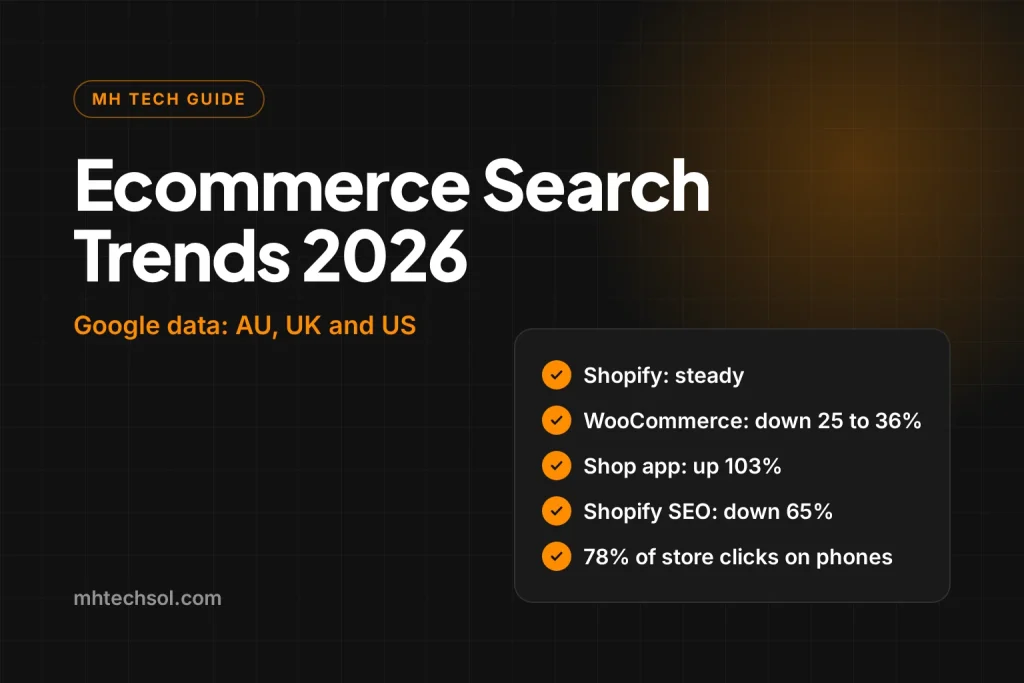
Google searches for Shopify held steady in the year to October 2026: unchanged in Australia, +4% in the United States and -8% in the United Kingdom. Searches for WooCommerce fell between 25% and 36%, BigCommerce between 34% and 43%, and Magento between 23% and 33%. The biggest change is in research searches about building a store: “Shopify SEO” fell 65%, “online store builder” 58% and “Shopify vs Wix” 49%, while searches for Shopify’s Shop app more than doubled.
This report uses 24 months of Google search data for Australia, the United Kingdom and the United States, plus anonymised Search Console figures from online stores we manage. The full data set is free to download at the end of the page.
Key findings
- Shopify is holding steady while older platforms fall. Shopify searches changed by -8% to +4% across the three countries. WooCommerce, BigCommerce and Magento fell between 23% and 43%.
- Shopify is searched far more than WooCommerce. About 34 times as often in the UK, 39 times in Australia and 48 times in the US. WooCommerce is a WordPress plugin, so many of its users search for WordPress instead, which makes this gap look larger than real usage.
- Squarespace grew slightly, Wix and Webflow fell. Squarespace grew 1% to 5%, Wix fell 6% to 19% and Webflow 18% to 22%.
- Research searches collapsed. Searches such as “Shopify SEO”, “ecommerce website”, “Shopify vs Wix” and “how to start an online store” fell 46% to 65%. Store owners are likely asking AI assistants like ChatGPT these questions instead.
- Phones bring most store traffic. Across five Shopify and WooCommerce stores we manage, 78% of Google search clicks came from phones, and product and category pages took 58% of all clicks. The homepage took only 22%.
Ecommerce platform searches: which are growing?
Blue: more searches. Red: fewer searches. Australia, the UK and the US combined.
Source: Google Ads Keyword Planner, Australia, United Kingdom and United States combined.
Searches a month for each platform, with the change on the year before:
| Platform | Australia | United Kingdom | United States |
|---|---|---|---|
| Shopify | 120,417 (no change) | 219,750 (-8%) | 1,036,667 (+4%) |
| Wix | 77,000 (-19%) | 226,667 (-9%) | 646,750 (-6%) |
| Squarespace | 74,250 (+1%) | 127,125 (+5%) | 665,000 (+4%) |
| Webflow | 9,758 (-21%) | 19,392 (-22%) | 71,125 (-18%) |
| WooCommerce | 3,092 (-30%) | 6,492 (-36%) | 21,717 (-25%) |
| BigCommerce | 1,767 (-34%) | 2,275 (-43%) | 15,967 (-37%) |
| Magento | 1,070 (-33%) | 2,808 (-33%) | 7,775 (-23%) |
Searches for a platform name mix existing users logging in with new stores looking for a platform, so they measure overall interest rather than market share. The direction over two years is the useful signal: interest is moving towards Shopify and Squarespace, and away from WooCommerce, BigCommerce and Magento.
Research searches about building a store fell sharply
Searches by people learning how to build or grow a store fell much faster than platform searches. “Shopify payments” is the only one that grew.
Blue: more searches. Red: fewer searches. Australia, the UK and the US combined.
Source: Google Ads Keyword Planner, Australia, United Kingdom and United States combined.
The likely reason is that people now research differently. A question like “is Shopify or WooCommerce better for a small store” is now often asked to an AI assistant, which answers from websites it trusts. For agencies and software brands, being cited in those answers now matters as much as ranking for the search. Our guide to generative engine optimisation explains how that works.
Marketplaces
Searches for the big marketplaces mostly fell, apart from eBay in the US.
| Marketplace | Australia | United Kingdom | United States |
|---|---|---|---|
| eBay | -10% | -5% | +11% |
| Etsy | -10% | -16% | -9% |
| TikTok Shop | -7% | -14% | -10% |
| Amazon seller | -15% | -13% | -15% |
Where store search traffic lands
Across five Shopify and WooCommerce stores we manage, with 8,540 Google search clicks between August and October 2026, 78% of clicks came from phones (between 72% and 86% per store). Product and category pages took more than half of all clicks.
Source: Google Search Console, five Shopify and WooCommerce stores managed by MH Tech Solutions, 8,540 clicks. Stores are not named.
For store owners the lesson is simple: category and product pages do most of the SEO work. A store that only optimises its homepage misses three quarters of its search traffic.
What this means for online store owners
- Treat category pages as landing pages. Give each important collection a clear title, a short useful introduction and buying advice. Our Shopify SEO checklist covers the details.
- Write product pages for buyers, not suppliers. Unique descriptions and answers to common questions help both Google and AI assistants.
- Build for phones first. More than three in four search visitors arrive on a phone, so speed and a simple checkout matter most there. Run our free website audit to check your store’s speed.
- Be the source AI assistants quote. With research searches falling, publish clear, factual guides and keep your business details consistent everywhere.
- If you are choosing a platform, read our comparison of Shopify and WooCommerce or our guide to moving from WooCommerce to Shopify.
Methodology
- Search volumes come from Google Ads Keyword Planner for Australia, the United Kingdom and the United States, in English, pulled on 22 November 2026. We compared average monthly searches from November 2025 to October 2026 with November 2024 to October 2025. Combined figures add the three countries together.
- Google rounds monthly volumes into ranges and groups close variants, so treat single months as estimates and the year on year direction as the reliable signal.
- Store figures come from Google Search Console for five Shopify and WooCommerce stores managed by MH Tech Solutions, August to October 2026. Stores are not named and figures are combined. Page types are classified from the page address.
Download the data and cite this report
Download the full data set (37 search terms, three countries, 24 months each) as a CSV file. You are welcome to use it. Please cite it as: MH Tech Solutions, Ecommerce Platform Search Trends 2026, mhtechsol.com, with a link to this page.
Frequently asked questions
Is Shopify growing in 2026?
Search interest in Shopify was steady in the year to October 2026: unchanged in Australia, up 4% in the US and down 8% in the UK, while most rival platforms fell further.
Is WooCommerce declining?
Searches for WooCommerce fell 25% to 36% across Australia, the UK and the US. Many WooCommerce users search for WordPress terms instead, so this shows falling interest in the name rather than an exact fall in use.
Why are searches like “Shopify SEO” falling?
Searches such as “Shopify SEO”, “ecommerce website” and “Shopify vs Wix” fell 49% to 65%. The most likely reason is that more people ask AI assistants these questions instead of searching Google.
How often will this report be updated?
We plan to update it every six months. The next update is due in May 2027.

Hamza is the founder and CEO of MH Tech Solutions, a Google Partner agency, with more than 8 years of experience in SEO, Google Ads and websites. He works with taxi companies, online stores and service businesses in Australia, the UK, the US and Europe.
Ready to Grow? Let's Talk.
No sales pitch. No fluff. Just an honest look at your digital presence and a clear plan to grow it. Free, with no obligation.