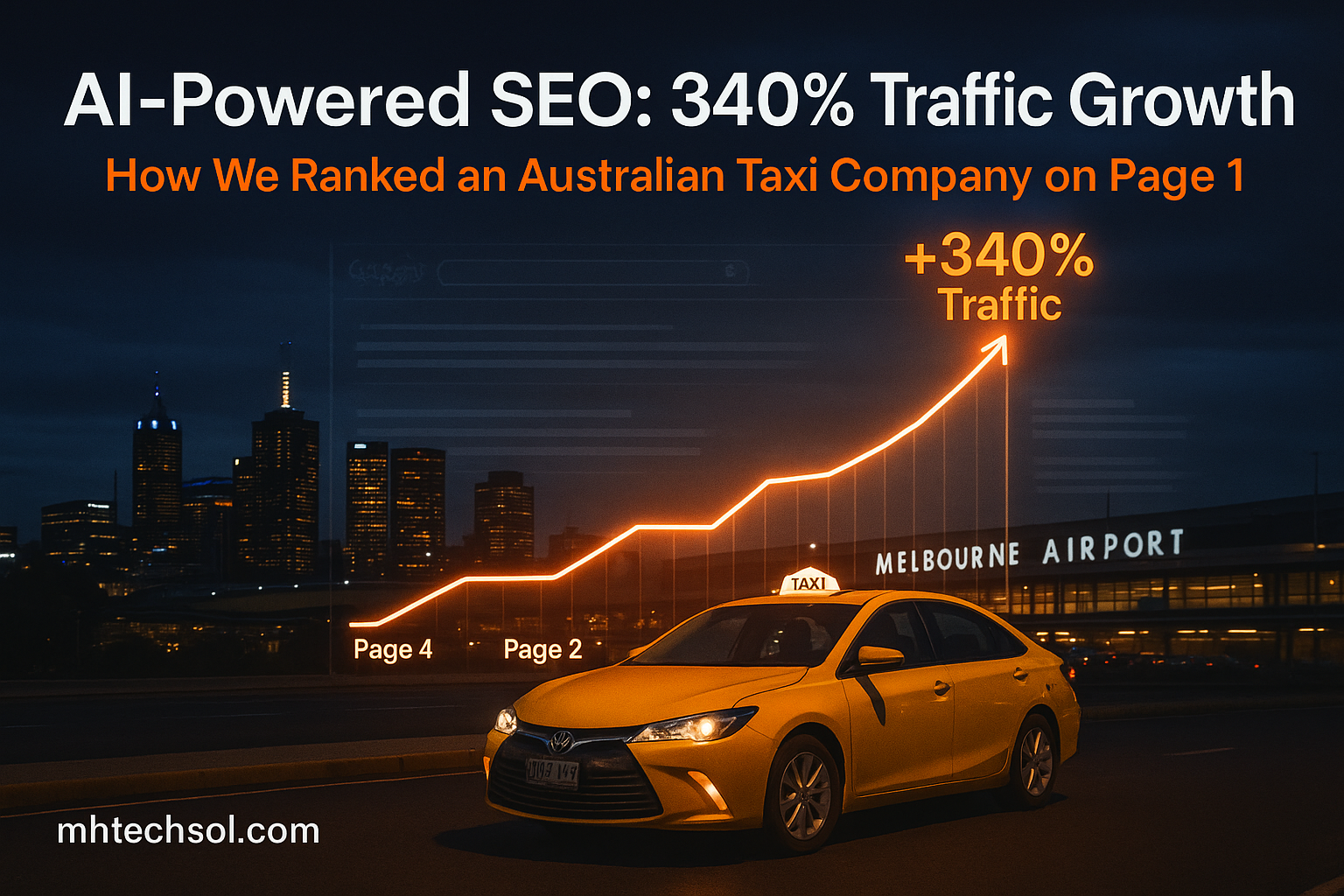
When 13 Melbourne Airport Taxi came to us, they were virtually invisible in Google search. Despite offering reliable, fixed-price airport transfers, they were buried on page 4 or 5 for almost every relevant search query. A competitor with a much weaker service was ranking #1 simply because they’d been investing in SEO longer.
The client’s goals were clear: rank on page 1 for Melbourne airport taxi searches, generate more direct bookings through the website, and reduce reliance on aggregator platforms that took a commission cut on every ride.
Traditional SEO — manually writing meta descriptions, basic keyword stuffing, hoping for backlinks — wasn’t going to cut it in a market this competitive. We needed a smarter system. Here’s what we built:
We used AI tools to analyse thousands of search queries and cluster them by search intent. Rather than targeting a single keyword like “Melbourne airport taxi”, we built topic clusters — groups of related keywords that all signal the same underlying user need. This let us create content that satisfied multiple search intents from a single page, dramatically improving coverage.
Key clusters we targeted included:
Melbourne’s suburban sprawl meant hundreds of potential location-based keywords. We built a programmatic page generation system that created unique, genuinely useful suburb-level pages — not thin, auto-generated spam, but properly structured pages with real information about travel times, local areas, and booking instructions. Google rewards pages that actually help users, and these did.
Google’s E-E-A-T framework (Experience, Expertise, Authoritativeness, Trust) rewards content that demonstrates real-world knowledge. We rewrote the service pages to include specific details that only someone with genuine experience in Melbourne’s taxi industry would know — like traffic patterns around Tullamarine, the difference between rideshare surge pricing and fixed-rate taxis, and why booking in advance beats flagging a cab outside the terminal at 5am.
Before any content work, we fixed the fundamentals: Core Web Vitals (LCP under 2.5s, CLS near zero), a clean URL structure, proper canonical tags, schema markup for LocalBusiness and Service types, and a site architecture that put every important page within 2 clicks of the homepage.
After 12 months of consistent execution:
The client now ranks above larger, older competitors for their most valuable search terms — including several where they were previously not even appearing in the top 100 results.
It’s worth being clear about what AI means in the context of SEO. AI doesn’t “do SEO for you” — it accelerates the research and analysis phase, so human strategists can make better decisions faster. At MH Tech Solutions, AI tools help us:
The strategy, the client knowledge, and the quality control are still human. AI just removes the tedious parts so we can focus on what actually moves the needle.
If you’re in a competitive local market — transport, trades, healthcare, hospitality — and your competitors are ranking above you, AI-assisted SEO can close the gap faster than traditional approaches. The key is having a team that knows how to use the tools properly, not just run them.
We offer SEO and content services for Australian and international businesses across multiple industries. Get a free proposal and we’ll show you exactly where your site stands and what it would take to reach page 1.
Hamza is a certified Google Partner with 5+ years of experience in digital marketing, SEO and AI automation. He helps businesses across Australia, UK, USA and beyond grow their online presence.
No sales pitch. No fluff. Just an honest look at your digital presence and a clear plan to grow it — free, with no obligation.