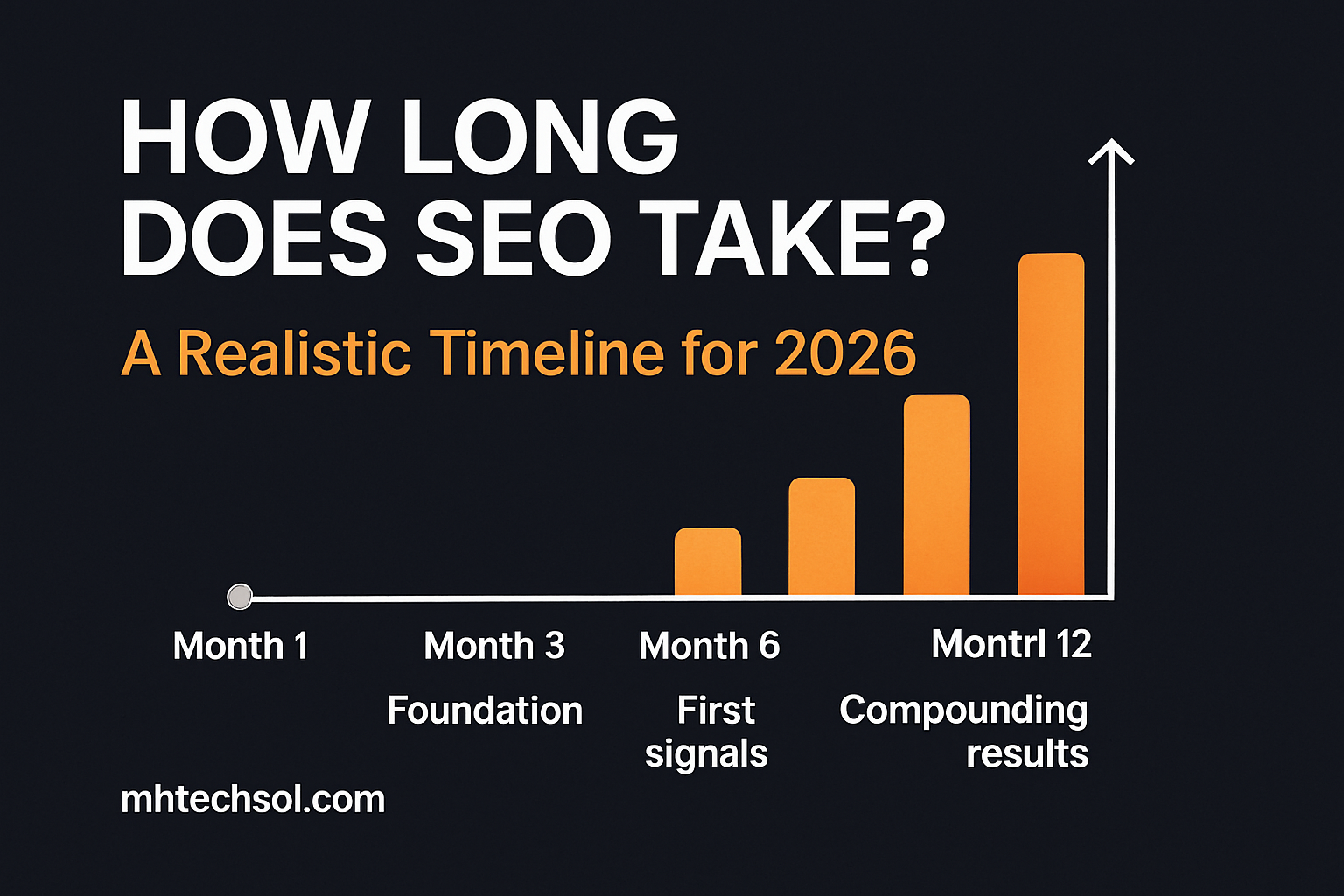
Most businesses see their first meaningful SEO signals, including ranking movements and impression growth in Google Search Console, within 60 to 90 days of starting a well-structured campaign. Significant organic traffic growth typically begins between months 3 and 6. A competitive niche with an established domain can reach meaningful rankings in 6 to 12 months. A new domain in a competitive space should expect 12 to 18 months before meaningful traffic arrives. These are honest ranges, not agency marketing language, and the factors that push you toward the shorter end of the range are within your control.
SEO takes 3 to 6 months for early ranking signals, 6 to 12 months for meaningful traffic gains, and 12 to 24 months for compounding authority that produces consistent, growing results. Every variable that affects this timeline, including your domain age, current technical health, content quality, link profile, and keyword targets, either shortens or extends it. A new website targeting competitive keywords will sit at the longer end. An established site in a low-competition niche can see results faster.
The frustrating answer to “why does SEO take so long” is that it is limited by Google’s own processes, not just the work you put in. Understanding those processes helps you set accurate expectations and identify what you can actually influence.
Before a page can rank, Google must crawl it and add it to the index. For new or low-authority sites, this process can take days to weeks per page. Even after indexing, a page typically spends weeks or months in what SEOs informally call the “Google sandbox,” a period where new content is assessed for quality signals before being granted stable rankings. This is not a Google penalty. It is a quality filter that disproportionately affects new domains and new content on established domains.
Google uses hundreds of signals to assess how authoritative a domain is on a given topic. The primary signals are backlinks from relevant, reputable sources, content volume and depth on the topic, and user engagement patterns (how users behave after clicking from Google). These signals accumulate over time. You cannot manufacture 12 months of earned authority in 4 weeks. A new domain starts with none of these signals and must build them from scratch.
Content published today does not have the engagement history, internal links, or external references it will have in 6 months. Google assesses pages partly on these signals. A page that has been live for 8 months with steady engagement, growing inbound links, and regular updates carries more trust than an identical page published last week. This is why SEO is a compounding investment: content published in month one becomes more valuable in month six, even without additional changes.
A brand-new domain starts with no authority, no indexed pages, no backlinks, and no engagement history. Months 1 to 3 are typically spent on technical setup, content publishing, and initial indexation. Months 3 to 6 produce first ranking movements, usually on low-competition long-tail keywords. Months 6 to 12 produce more consistent traffic if content and links are building steadily. Months 12 to 18 is where new sites in competitive niches start seeing meaningful, compounding results. This timeline is not a failure; it is the honest reality of building from zero.
A site that has existed for 2 or more years, has some indexed content, and has a modest backlink profile has a significant head start. The technical foundation is usually closer to working. Google already trusts the domain to some degree. A well-structured SEO campaign on this type of site typically produces meaningful ranking improvements in 3 to 6 months and measurable traffic growth within 6 to 9 months. The exact timeline depends on how competitive the target keywords are and how much historical technical debt the site is carrying.
If your site has crawlability issues, broken pages, thin duplicate content, or Core Web Vitals failures, SEO work begins with fixing those foundations before rankings can move. Depending on the severity of the issues, this technical repair phase can take 4 to 12 weeks. Add that time to whatever baseline timeline applies to your situation. Fixing technical issues is not wasted time. It is the work that makes everything else possible.
Keyword difficulty matters. A law firm targeting “personal injury lawyer Sydney” is competing against large, well-established firms with enormous content libraries and thousands of backlinks. A specialist physiotherapy clinic targeting “neck pain physiotherapy Geelong” is competing against a much smaller field. The tactical work is similar but the timeline to the same ranking position can be 3 times longer in the competitive niche. We tell clients this during the proposal stage, not six months in.
The amount of high-quality content published per month is one of the strongest controllable factors. A campaign publishing 4 to 6 substantive pieces per month builds topical authority faster than one publishing 1 piece per month. Content production is often where budget constraints create the biggest gap between fast and slow campaigns. More budget also means more link acquisition, which accelerates authority building.
A site that Google can crawl efficiently, that loads quickly, and that has no indexation errors gives the algorithm more signals to work with. A technically broken site limits how much of your content Google sees. We run a technical audit as the first step of every SEO engagement to identify and fix blocking issues before anything else.
External links from relevant, authoritative sites remain one of the strongest ranking signals Google uses. The rate at which new quality links are acquired directly affects how quickly authority builds. For competitive keywords, link building is not optional. It is the mechanism that pushes rankings past competitors who have been building links for years.
The keyword difficulty score available in most SEO tools gives a rough proxy for how competitive a term is. A keyword with a difficulty score of 20 can realistically be moved to page one within 3 to 6 months for an established site. A keyword with a score of 70 might take 18 months or longer for the same site. Prioritising medium-difficulty keywords in the first 90 days generates early wins while long-term target keywords are being built toward.
Rankings are a lagging indicator. By the time you see ranking movement, several earlier signals have already been accumulating. These are the signals we track to confirm a campaign is working before rankings become visible:
You cannot shortcut Google’s evaluation timeline, but you can stack the conditions that make the evaluation go faster. The highest-impact actions are: publishing more high-quality content more frequently, fixing all technical issues immediately rather than deferring them, acquiring quality backlinks consistently each month, and investing in content that targets lower-competition keywords first to build early wins while harder keywords develop.
Running Google Ads in parallel with SEO provides a useful supplement. Ads generate immediate traffic and conversion data that helps identify which landing pages and messaging actually work. That data informs which SEO content is worth prioritising. It does not speed up SEO directly but it means you are not waiting on a revenue gap while the organic campaign builds.
Across 300+ client engagements, here is what we typically see for a small-to-medium business starting with an established domain and a moderate backlink profile:
Domain age, accumulated backlinks, and content volume are the most common reasons. A competitor who has been publishing SEO-optimised content for 4 years has a structural advantage that cannot be closed in 3 months. The strategic response is to find topics where the competitive gap is smaller, build authority there first, and use those wins to fund the longer campaign for competitive terms.
Three months is long enough to assess whether a campaign is set up correctly and whether leading indicators are moving. It is not long enough to judge final traffic outcomes. At 3 months, you should see impression growth, some early ranking movements, and evidence that technical issues are resolved. If none of those signals are present at 3 months, something is wrong with the strategy or execution, not with SEO as a channel.
Not directly. Google has confirmed that running Google Ads does not improve organic rankings. But the data from paid campaigns, which keywords convert, which ad copy performs, which landing pages work, is genuinely valuable for SEO strategy. Businesses that run both channels learn faster which content investments are worth making.
If you want to know where your site stands today and what a realistic 12-month SEO trajectory looks like for your specific situation, we offer a free audit with no obligation to proceed. We review your technical health, current rankings, backlink profile, and competitive landscape and give you an honest timeline based on what we find.
Our SEO services cover the full campaign from technical audit through to link building and content strategy. Get a free audit and we will tell you exactly what we would do and how long it would take.
Hamza is a certified Google Partner with 5+ years of experience in digital marketing, SEO and AI automation. He helps businesses across Australia, UK, USA and beyond grow their online presence.
No sales pitch. No fluff. Just an honest look at your digital presence and a clear plan to grow it — free, with no obligation.