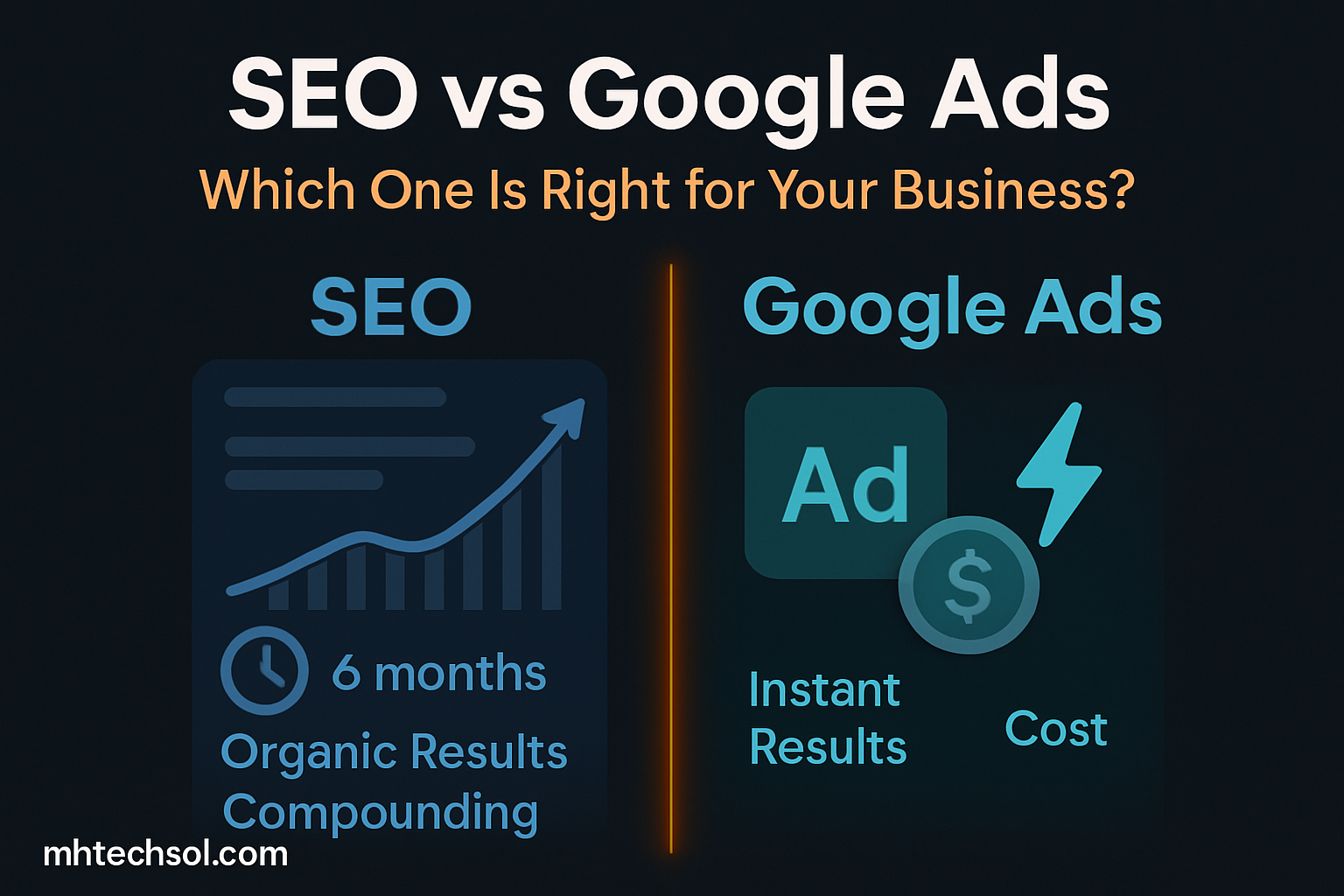
SEO and Google Ads are both legitimate channels for growing online visibility, but they work in fundamentally different ways, at different speeds, and with different cost structures. The right choice depends on your timeline, budget, competitive landscape, and where you are in your business growth. For most small and medium businesses, the honest answer is not “SEO or Google Ads” but “how do we use both effectively within our budget.”
If you need traffic and leads now and have budget to spend on a per-click basis, start with Google Ads. If you want to build a long-term organic traffic asset that compounds in value over time without ongoing per-click costs, invest in SEO. If your budget allows both, running them in parallel produces better results than either channel alone: Ads generate immediate data on what converts, SEO builds the asset that eventually reduces your dependence on paid traffic.
Search Engine Optimisation (SEO) is the process of improving a website so that it appears higher in Google’s organic (unpaid) search results for relevant queries. It works by making a site easier for Google to crawl and understand, building the domain’s authority through high-quality backlinks, and publishing content that matches what searchers are looking for at each stage of the buying process.
SEO is not a quick fix and it is not free. It requires ongoing investment in content, link acquisition, and technical maintenance. The payoff is that once rankings are established, organic traffic continues arriving without a per-click cost. A well-ranked page can generate leads for months or years without additional spend beyond maintaining the campaign.
SEO delivers organic search traffic, which is visitors arriving at your site through unpaid Google results. For most service businesses and ecommerce stores, organic traffic from SEO is the highest-volume, lowest-cost-per-lead channel over a 2 to 3 year horizon. It also builds brand credibility: appearing in position one for your key terms signals authority to searchers in a way that paid ads do not.
Early ranking signals typically emerge within 60 to 90 days. Meaningful traffic growth usually begins between months 3 and 6. For competitive keywords and new domains, significant results take 12 months or longer. See our full guide to SEO timelines for a detailed breakdown by business situation.
Google Ads is Google’s paid advertising platform. Advertisers pay to appear at the top of search results for specific keywords. You bid in a real-time auction each time a user searches for a relevant query. The position you achieve depends on your bid, your ad quality score, and the relevance of your landing page to the query. You pay only when someone clicks your ad, which is why Google Ads is often called pay-per-click (PPC) advertising.
Unlike SEO, Google Ads generates traffic immediately once a campaign is live. There is no waiting period for Google to build trust in your domain. The trade-off is that the traffic stops the moment your budget runs out or you pause the campaign.
Google Ads delivers immediate, targeted traffic from users actively searching for what you offer. For lead generation businesses, a well-structured Search campaign can deliver qualified enquiries within days of launch. For ecommerce, Google Shopping campaigns can drive purchase-intent traffic directly to product pages. The campaign data also produces valuable intelligence: which keywords convert, which ad messages resonate, which landing pages work.
Most properly set-up campaigns produce their first leads or sales within the first week. The first 30 days involve a learning phase where Google’s algorithm gathers conversion data to optimise bidding. Performance typically improves meaningfully in weeks 4 to 8 once the algorithm has enough data to work with. For new campaigns, budget in the first 30 to 60 days as part of the setup cost, not pure return.
SEO: An agency retainer for small to medium businesses typically runs between $500 and $2,500 per month depending on scope, competitiveness, and whether content production is included. There is no per-click cost. Once rankings are achieved, the traffic cost per lead decreases over time as the organic position becomes more established.
Google Ads: You pay the agency management fee (typically 10 to 15% of ad spend, or a flat fee of $500 to $1,500 per month) plus the ad spend itself. Ad spend varies enormously by industry. A competitive service keyword in a major city can cost $5 to $30 per click. For a business generating 20 leads per month at a $15 average CPC with a 5% conversion rate, that is $1,500/month in ad spend alone, plus the management fee.
Google Ads: Results within days of launch. Traffic stops immediately if you pause spending.
SEO: 3 to 6 months for early results. 6 to 12 months for meaningful traffic. Results continue and compound even if you pause active link building for a period.
Both channels target people actively searching for your product or service, which makes them both higher-intent than display advertising or social media. The quality difference is subtle: SEO traffic often has slightly higher trust (organic results are perceived as more impartial than ads), while Google Ads traffic is more controllable in terms of which keywords and geographies you target.
This is where SEO has a structural advantage. A Google Ads campaign delivers return exactly proportional to your spend. Stop spending, return stops. An SEO campaign builds an asset. A page that reaches position one continues generating traffic and leads with minimal additional investment. The cost per lead from SEO typically decreases year over year. The cost per lead from Google Ads tends to increase as competition for keywords grows.
Over a 3-year horizon, businesses that invest in SEO consistently outperform those that rely exclusively on Google Ads on a cost-per-lead basis. But you have to survive the first 12 months to get there.
SEO is the right priority when: you have time but limited per-click budget; you are in a category where organic results are trusted more than ads (professional services, healthcare, legal); you want to build a durable marketing asset that does not disappear if you pause spending; or you are already running Google Ads and want to reduce your long-term dependency on paid traffic.
Google Ads is the right priority when: your business is new and needs leads immediately; you are launching a new product or offer and need rapid market testing; your SEO is still being built and you cannot wait 6 months for organic traffic; you are in a seasonal business where demand is concentrated in a short window; or you have identified specific high-value keyword opportunities where you can profitably bid and win.
The most effective approach for most small and medium businesses is a phased combination. In months 1 to 6, run Google Ads to generate immediate leads while SEO builds. Use the Ads data to identify which keywords, offers, and landing pages actually convert. Feed that data into your SEO content strategy so you are building organic content around proven winners, not assumptions.
From month 6 onward, as organic rankings begin producing traffic, you can reduce Ads spend on keywords where you have achieved strong organic positions, redirecting that budget to keywords where you still need paid support. Over 12 to 24 months, a business that runs this strategy typically achieves a lower blended cost per lead than one relying on either channel exclusively.
Running both channels also provides data resilience. Google algorithm updates can temporarily affect organic rankings. Google Ads can sustain traffic during those periods. A Google Ads policy issue can temporarily pause paid traffic. Organic rankings continue working. Neither channel should be your only one.
For a brand-new website, Google Ads is typically the faster path to initial leads. A new domain has no authority and will take 12 to 18 months before competitive organic rankings are realistic. Google Ads can generate leads from day one. The right approach is to start Ads immediately and simultaneously invest in SEO so the organic asset starts building. By month 12, SEO begins to contribute and you can start reducing Ads spend on terms where organic now performs.
Yes. Running both channels simultaneously is the recommended approach for most businesses with sufficient budget. They are not competing with each other. Your Google Ads traffic does not reduce your organic rankings and vice versa. Running both gives you faster learning (what converts from Ads data), broader search result coverage (appearing in both paid and organic positions increases click share), and more resilience against channel disruptions.
A common starting allocation for a business with a total digital marketing budget of $2,000 to $3,000 per month is: $1,000 to $1,500 on Google Ads management plus ad spend to generate immediate leads, and $800 to $1,200 on SEO to build the long-term asset. As SEO produces results and reduces your cost per organic lead, you can maintain or grow the Ads budget on terms where SEO is not yet competitive, rather than reducing it. The goal is growth, not channel substitution.
We work with businesses across SEO and Google Ads management. We offer a free 30-minute strategy session where we review your site, current traffic, competitive landscape, and budget to give you an honest recommendation on where to start and what the realistic trajectory looks like. No sales pressure and no obligation to proceed.
Hamza is a certified Google Partner with 5+ years of experience in digital marketing, SEO and AI automation. He helps businesses across Australia, UK, USA and beyond grow their online presence.
No sales pitch. No fluff. Just an honest look at your digital presence and a clear plan to grow it — free, with no obligation.