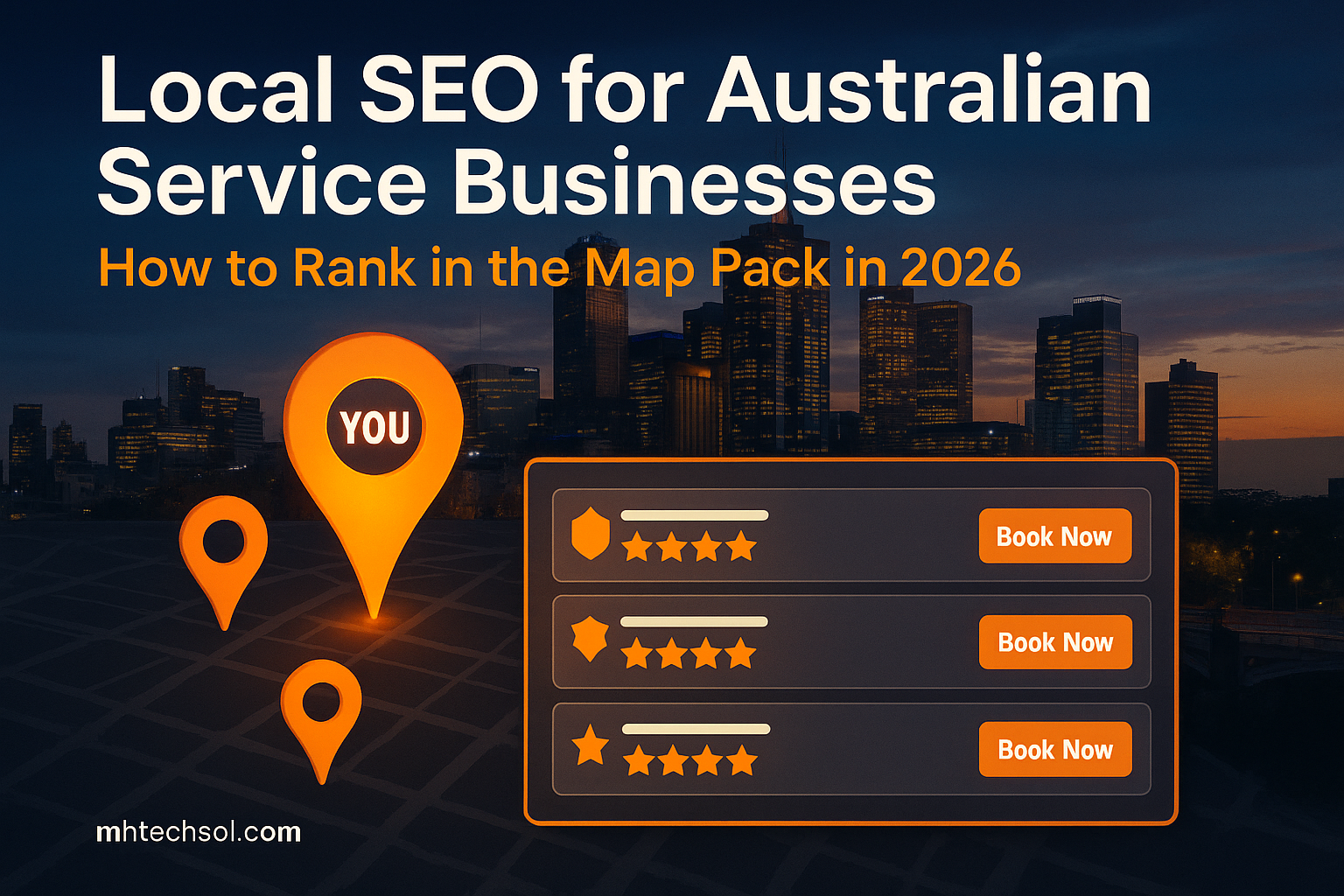
When someone in Melbourne searches “taxi service near me” or “plumber Geelong,” Google typically shows a three-business panel at the top of the results — above organic listings, below ads. This is the local map pack, powered by Google Maps and Google Business Profile data. The three businesses shown receive approximately 42% of all clicks on the page. Position 4 — the first organic result below the map pack — gets a fraction of that.
For Australian service businesses, the map pack is the single highest-value piece of digital real estate available. It requires no ad spend. It delivers high-intent local customers actively searching for what you offer. And unlike paid ads, a strong map pack position compounds over time as your reviews and engagement signals build.
The challenge is that only three businesses appear at any one time. Competition for those three spots is intensifying in every Australian city and regional centre. This guide covers exactly what it takes to earn and hold a map pack position in 2026.
Your Google Business Profile (GBP) is the primary signal Google uses to determine your local rankings. A partially completed profile is one of the most common reasons businesses fail to appear in the map pack despite having a legitimate, established operation.
NAP stands for Name, Address, Phone number — the three pieces of information that identify your business across the web. NAP consistency means that these details are identical (not just similar) across every online directory, citation, and mention of your business.
Google cross-references your GBP data against hundreds of other sources to verify that your business is legitimate and located where you say it is. Inconsistencies — a different phone number on Yelp, an old address on TrueLocal, a name variation on Yellow Pages — create uncertainty in Google’s entity understanding of your business, which suppresses local rankings.
The most efficient approach is to use a citation audit tool (BrightLocal or Whitespark are the standard tools) to pull your citations from 40+ directories and flag discrepancies. Manually fixing each citation through each directory’s editing process is tedious but necessary. Priority directories for Australian businesses include: Google Business Profile, Yelp Australia, True Local, Hotfrog, Yellow Pages Australia, Bing Places, Apple Maps, Facebook, LinkedIn, and your industry-specific directories.
After cleaning up existing citations, suppress any duplicate GBP listings — duplicate profiles split your review equity and confuse Google about which listing to rank.
Reviews are a top-three local ranking factor and the single most influential trust signal for prospective customers. Yet most businesses rely entirely on organic reviews — customers who are motivated enough to leave feedback without being asked. That means you’re capturing reviews predominantly from unhappy customers, because complaint motivation is higher than satisfaction motivation.
A systematic review generation strategy changes that ratio.
Negative reviews handled well become trust signals. Respond within 24 hours, acknowledge the concern specifically (not generically), offer a resolution, and move the conversation offline. Never be defensive. Potential customers reading reviews are not judging the negative review — they are judging your response to it. A professional, empathetic response to a 1-star review can be more persuasive than a 5-star review with no response.
Ranking in the map pack covers the city or suburb where your business is located. But what about customers in surrounding suburbs — the person in Dandenong searching for a taxi to the airport, or the Frankston resident needing a plumber?
Local landing pages — individual pages targeting specific suburbs or service-area combinations — allow you to rank in organic results for location-specific queries that the map pack alone cannot capture.
The formula is: [Service] + [Suburb]. A Melbourne taxi company creating a page titled “Taxi from Dandenong to Melbourne Airport” with 600+ words of genuine, helpful content (covering the route, pricing, booking process, and frequently asked questions) can rank organically for that specific query and adjacent long-tail variations.
The risk is thin content. Pages that are just a template with the suburb name swapped out — identical content replicated 50 times with a location variable — are penalised by Google’s Helpful Content system. Each page must contain genuinely useful, suburb-specific information. This is more work, but it also means competitors are less likely to replicate it at scale.
Learn more about our local SEO services and how we structure location page campaigns for Australian service businesses.
A citation is any online mention of your business’s NAP details — on a directory, a review site, a social profile, or a local news article. Quality citations come from established, high-authority sources that Google already trusts.
Beyond these general directories, industry-specific citations carry additional weight. A restaurant listed on Zomato and OpenTable, a tradie listed on HiPages and Hipages, or a medical practice listed on Healthdirect are all receiving category-relevant citation signals that reinforce their Google entity.
One of our Australian transport clients came to us with a GBP profile that was 40% complete — no photos, no service list, and only 11 reviews accumulated over four years of operation. They were invisible in the map pack for their core city-area queries.
Over a 90-day engagement, we completed the GBP profile across all 11 elements, implemented a post-ride SMS review request system, cleaned up 23 NAP inconsistencies across Australian directories, and launched 15 suburb-level landing pages targeting airport transfer queries from specific Melbourne suburbs.
The results: map pack appearances grew by 300% (measured via GBP Insights impressions), GBP phone calls increased by 180%, and organic traffic to the suburb landing pages generated an additional 40+ booking enquiries per month within 60 days of publication.
This kind of outcome is repeatable for any Australian service business with a genuine local presence and a commitment to systematic execution. Our reputation management service includes the review generation system, GBP management, and citation building as an integrated package.
Local SEO is a compounding investment. The review you earn today contributes to your ranking for the next five years. The citation you fix today removes a ranking suppressor that may have been holding you back for years. The suburb landing page you publish today starts accumulating authority and rankings within 60-90 days.
The businesses that dominate the Australian local map pack in 2026 are not the ones running the most ads or spending the most money. They are the ones that have done the systematic, unglamorous work of completing their GBP profile, fixing their citations, earning consistent reviews, and publishing genuinely useful local content.
If your business is not ranking where it should, our team at MH Tech Solutions can show you exactly why — and fix it. Start with our SEO audit and content strategy, or contact us for a local SEO consultation specific to your business and location.
Hamza is a certified Google Partner with 5+ years of experience in digital marketing, SEO and AI automation. He helps businesses across Australia, UK, USA and beyond grow their online presence.
No sales pitch. No fluff. Just an honest look at your digital presence and a clear plan to grow it — free, with no obligation.