Your conversion rate is the percentage of website visitors who complete a desired action — making a purchase, submitting an enquiry form, calling your business, or booking an appointment. The formula is simple: conversions divided by visitors, multiplied by 100.
If your site had 10,000 visitors last month and 150 of them submitted an enquiry form, your conversion rate is 1.5%. That number is not abstract. It has a direct dollar value.
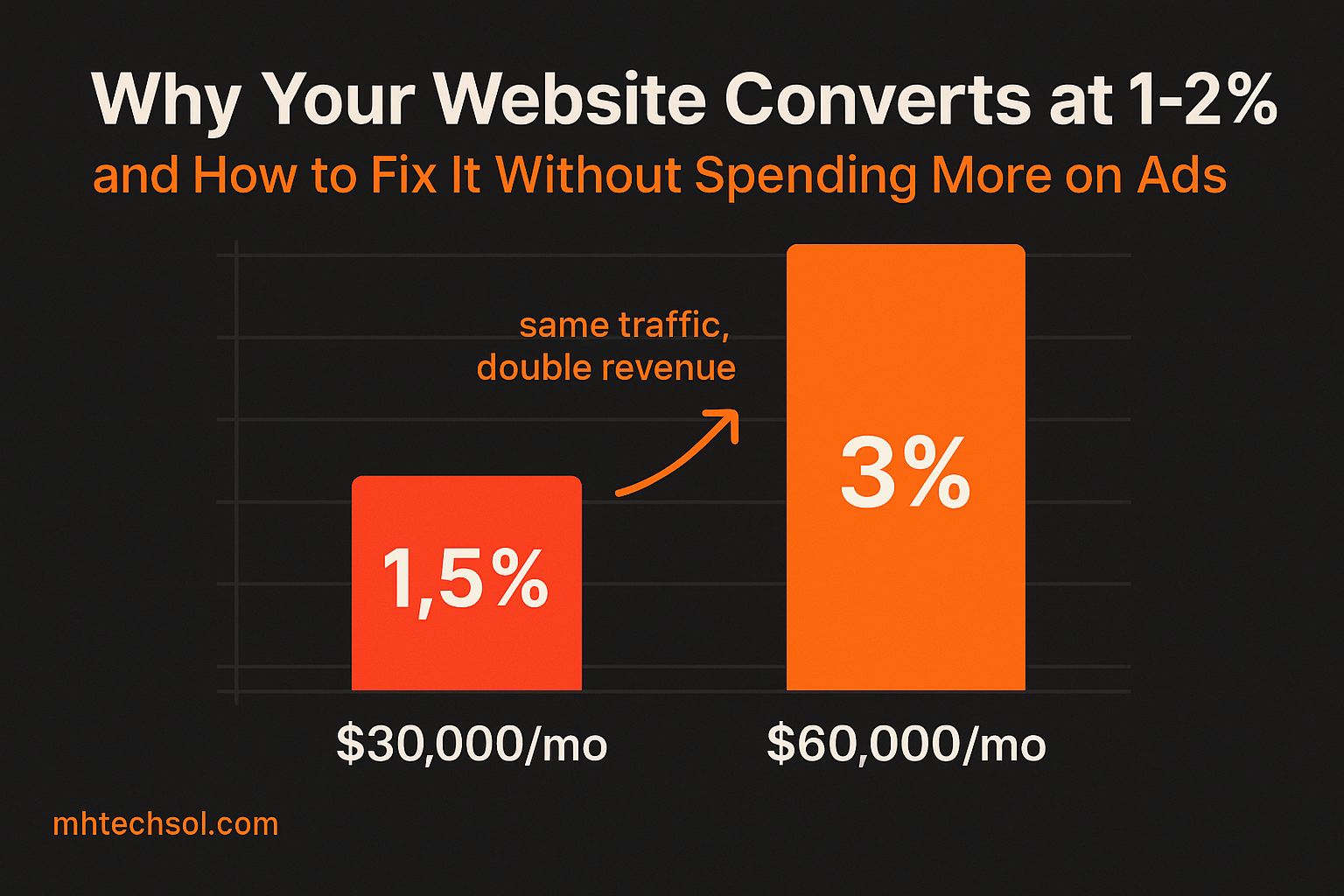
At 1.5% conversion with 10,000 monthly visitors, you are getting 150 leads. If your average lead is worth $200 in revenue, that is $30,000 per month. Move that conversion rate to 3% — same traffic, no additional ad spend — and you are generating 300 leads and $60,000 per month. The traffic cost stays the same. The output doubles.
This is the core insight behind Conversion Rate Optimisation (CRO): the most efficient way to grow revenue is often not to spend more on acquiring traffic, but to convert more of the traffic you already have.
Most business owners have no idea whether their conversion rate is good or poor, because they have no benchmark to compare against. Here are the industry averages that matter:
Being below your industry benchmark is not just an efficiency problem — it is a real cost. If the industry average for your sector is 3% and you are converting at 1.5%, you are effectively getting half the output from every dollar you spend on SEO, Google Ads, and social media. Every underperforming conversion rate is a tax on your marketing investment.
In our experience auditing dozens of Australian and international websites, the same five problems appear repeatedly. They are rarely the result of bad design alone — they are usually structural issues that emerged from building a website without conversion in mind.
Within 5 seconds of landing on your homepage, a visitor should be able to answer: what do you do, who do you do it for, and why should I choose you over a competitor? Most websites fail this test. The headline says something generic like “Welcome to [Company Name]” or “Your Trusted Partner in [Industry]” — phrases that say nothing and differentiate nothing.
A strong value proposition is specific. “Airport transfers across Melbourne — fixed prices, no surprises, 24/7” communicates the service, the geography, the pricing model, and a key trust signal in one sentence.
Google and multiple independent studies have confirmed: a 1-second delay in page load time reduces conversions by approximately 7%. A 3-second delay can reduce conversions by 20% or more. On mobile — where the majority of Australian web traffic now originates — slow sites are abandoned immediately.
Page speed is not just a technical SEO issue. It is a CRO issue. A site loading in 4 seconds versus 1.5 seconds is not just ranking lower — it is converting a fraction of what it could.
Analysis paralysis is real. A page with five different calls to action — “Call us,” “Request a quote,” “Download our guide,” “Subscribe to our newsletter,” “View our portfolio” — forces the visitor to decide which action is most relevant to them. The cognitive load causes them to choose nothing.
Conversely, pages with no clear CTA — that present information but provide no obvious next step — leave visitors who are ready to act with nowhere to go. Every page should have a primary CTA that is visually prominent and contextually obvious. Secondary CTAs should be clearly subordinate.
The “fold” is the portion of the page visible without scrolling. Research consistently shows that the majority of users who do not scroll past the fold are lost — they form their impression and make a decision based entirely on what is immediately visible.
If your trust signals — reviews, client logos, certifications, guarantees, years in business — are buried below the fold, a large portion of your visitors are deciding whether to enquire without ever seeing them. Move your most compelling trust signals (particularly star ratings and recognisable client logos) into the hero section of your page.
In Australia, over 60% of web traffic is now mobile. A site that looks excellent on desktop but requires pinching to zoom, has forms with fields too small to tap accurately, or has a phone number that is not click-to-call is losing a significant portion of its potential conversions before they even start.
Mobile CRO is not just about responsive design — it is about rethinking the user journey for thumb-first navigation, shorter attention spans, and the expectation of instant gratification that mobile users bring.
A CRO audit is not a gut-feel exercise. It is a data-driven investigation of exactly where visitors are dropping off and why. These are the four tools that form the foundation of a professional CRO audit:
Not all CRO improvements require a full redesign or months of testing. Some changes deliver meaningful conversion lifts within days of implementation. These are the quick wins we implement first for new clients:
An A/B test presents two variants of a page to randomly selected visitors — 50% see the original (A), 50% see the changed version (B) — and measures which converts better. Done correctly, it removes guesswork and gives you statistically reliable evidence for what works.
The most important things to understand about A/B testing:
AI is changing CRO in three practical ways that are already accessible to businesses of any size.
First, automated heatmap and session recording analysis. Tools like Microsoft Clarity (which MH Tech uses for client audits) use AI to flag sessions with rage clicks, dead clicks, quick backs, and scroll depth anomalies — surfacing the most relevant recordings without requiring you to watch hours of footage manually.
Second, personalisation at scale. AI-powered personalisation tools can serve different page content to different visitor segments — returning versus new visitors, visitors from different geographic areas, visitors who arrived from different traffic sources — without requiring manual segmentation or multiple page versions.
Third, AI-assisted chatbots for conversion capture. A well-trained AI chatbot can handle initial enquiry qualification, answer common pre-purchase questions, and book appointments — converting visitors who arrive outside business hours or who are not ready for a direct phone call. Our AI chatbot and automation service includes CRO-focused chatbot configuration as part of the implementation.
Consider a business with 50,000 monthly visitors converting at 1.5%. That is 750 leads per month. If their average lead-to-client conversion rate is 20% and their average client value is $1,500, that is 150 new clients and $225,000 in monthly revenue from their website.
Move that website conversion rate from 1.5% to 3% — through the kinds of systematic improvements described in this guide — and the same 50,000 visitors generate 1,500 leads, 300 new clients, and $450,000 in monthly revenue. Same traffic. Same ad spend. Same SEO investment. Double the output.
This is not a theoretical scenario. This is what happens when a business treats its website as a conversion system rather than a digital brochure.
The first step is understanding where you are losing conversions and why. A professional CRO audit will identify the specific pages, specific elements, and specific user behaviours that are suppressing your conversion rate — and prioritise the changes by expected impact.
MH Tech Solutions offers CRO audits and ongoing optimisation as part of our conversion rate optimisation service. We use heatmaps, session recordings, funnel analysis, and A/B testing infrastructure to systematically improve conversion rates for businesses across Australia, the UK, USA, and beyond.
If your website’s traffic is already solid but your leads are not where they should be, the answer is almost never “spend more on ads.” The answer is fix the conversion system. Start with a website review from our team to understand what your site is currently leaving on the table.
A 1-2% conversion rate is not a law of nature. It is a symptom of a website that was built without systematic conversion thinking. The businesses converting at 4-6% are not doing so because of luck or a bigger budget — they are doing so because they have audited their user experience, tested their assumptions, and made evidence-led improvements to the elements that move the needle.
The conversion rate gap between the average website and an optimised one represents real revenue sitting on the table. The question is whether you want to claim it.
Hamza is a certified Google Partner with 5+ years of experience in digital marketing, SEO and AI automation. He helps businesses across Australia, UK, USA and beyond grow their online presence.
No sales pitch. No fluff. Just an honest look at your digital presence and a clear plan to grow it — free, with no obligation.